

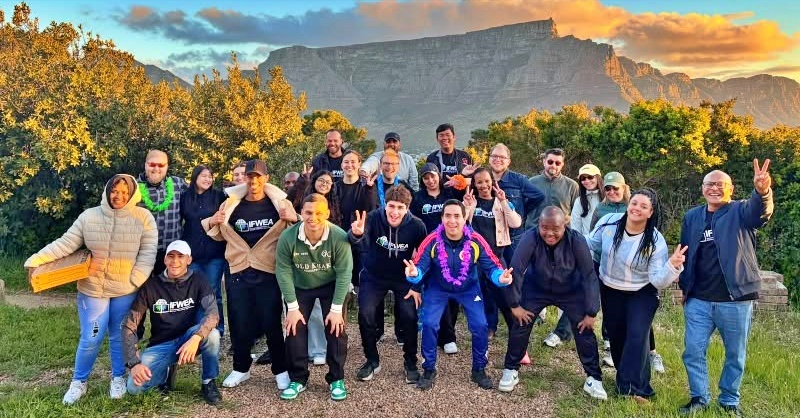
YGAP 2026 welcomed 16 participants from ten countries for the annual gathering of young activists and leaders from the global workers movement. The intensive two-week immersion was held in October at Community House in Cape Town, South Africa as well as at selected community organisations. The programme of dynamic debates, discussions and practical hands-on experience with an emphasis on understanding the concepts of power and empowerment.
Participative exercises as well as input from partner organisations and affiliates helped in recognising power and power structures, as well as identifying popular education frameworks, tools, exercises and methodologies for empowerment. YGAPers were encouraged to share their own experiences, and the work that they do in their organisations, to build up a shared understanding.
“I learned that a strong union is not only about the number of members. It is also about knowledge, education, and active participation.” – Ardiansyah Ardian, Federasi Serikat Pekerja Metal Indonesia (FSPMI)
YGAP PROGRAMME HIGHLIGHTS
Organising and acting together
Dina Feller, from IFWEA Argentinian affiliate INCASUR, introduced the Power Resources Approach and tools for building trade union power.
In an interactive role-play Dina facilitated, YGAPers stepped into the shoes of employers and workers to explore the different sources of power available to each side. From money, information and political influence to collective action, solidarity and organisation, participants discovered an important lesson: workers’ greatest strength lies in their ability to organise and act together!
“YGAP strengthened my perception that workers’ education goes far beyond simply providing information about labor rights. It is a powerful tool for building critical consciousness, developing leadership, strengthening solidarity, and empowering workers to actively participate in the decisions that impact their lives and communities.” – Domingos Dionisio Américo, Organization of Mozambican Workers (OTM-CS)
Speaking up without fear
Otto Köngas, from IFWEA affiliate Työväen Sivistyliitto (TSL) facilitated sessions on leadership, power and safer spaces in activism and organising.
Participants explored what makes a good leader, why sharing responsibilities matters, and how organisations can avoid depending on just a handful of people. They also had some important conversations about respect, abuse of power and creating safer spaces where people can speak up without fear.
Learning is a collective process
Aida Zekic, from IFWEA affiliate Workers’ Educational Association of Sweden (ABF), facilitated a fun, interactive session on defining popular education and education for empowerment.
Using a giant puzzle, participants explored the key concepts behind education for empowerment. Working in small groups, they discussed what each piece meant, why it mattered and how it contributed to education for empowerment. They could also add their own missing pieces! Wonderful discussions came out when everyone worked together to assemble the puzzle, negotiating, rearranging and connecting the pieces until they reached a shared understanding of education for empowerment.
The exercise brought to life the idea that learning is a collective process, built through participation, dialogue, sharing experiences and learning from one another.
“One of the biggest highlights was meeting young people from different backgrounds, sharing experiences and learning from one another.” – Rosina Engelbrecht, Metal and Allied Namibian Workers Union (MANWU)
Empowerment can take many forms
IFWEA General Secretary Saliem Patel got YGAPers thinking about a simple but important question: What does Education for Empowerment actually mean in our lives and work?
Participants shared pictures and drawings representing moments when they had experienced empowerment – from finding the confidence to speak up and workers organising for better conditions, to supporting refugees and creating opportunities for others through education.
They then identified the values that mattered most to them, including trust, community, meaningfulness, choice and social change. Working in pairs, they turned these shared values into ideas for action. A session full of ideas, experiences and possibilities – showing that empowerment can take many forms, but it starts with understanding what matters to people and finding ways to make it happen.
“YGAP reinforced my understanding that education is not simply about transferring knowledge; it is about recognising power, questioning structures, and building the confidence to act collectively.
Coming from Palestine, where injustice and unequal power relations shape so much of our daily reality, this was particularly meaningful to me.
I believe worker education becomes truly transformative when it moves beyond awareness and enables people to recognise their collective power, challenge inequalities, and actively participate in shaping the decisions that affect their lives.” – Yara Ramadan, Ibtikar for Empowerment and Social Entrepreneurship
Inspiring action through storytelling
How can we tell stories that connect with people and inspire action?
Storytelling is a powerful popular education method. It starts with people’s own experiences, giving them a way to share knowledge, explore different perspectives and make sense of the issues that affect their lives. It is one of the many creative ways we can make education empowering.
As part of the YGAP Programme, South African actress, puppeteer and theatre-maker Tshiamo Moretlwe facilitated a storytelling workshop, sharing creative tools to help participants craft and tell impactful stories. The experience continued as YGAPers joined StoryJam, a live African storytelling showcase in Cape Town.
Postcards from YGAP
The inspiration from the workshop and StoryJam carried into the YGAPers’ final Postcard presentations, where they used creative projects to tell stories drawn from their experiences and learning throughout the programme. These are stories they will take back to their own organisations and countries.