


Please let us a bit about your background – where you grew up, where you studied, what shaped your surroundings?
Until I was 10, I grew up in Johannesburg, South Africa, and then moved with my family to Cape Town. My childhood experiences were heavily shaped by apartheid policies at the time. As a white kid, I had access to all the privileges, including my school and university education. I studied economic history at UCT during the height of the mass uprisings in South Africa (1984-1987) and became very involved in the student and youth movements. The 80s were a very defining period for me and shaped my activism until this day. And of course, political education was a big part of this.
You’ve worked in the trade union movement for most of your life. What first drew you to unions and to workers’ education? And what led you to joining the International Transport Worker’s Federation (ITF)?
When I was in the student movement at UCT, I was an active member of Wages Committee. The main role of this committee was to build the alliance between students and workers. Through this experience, I began to understand the importance of industrial organising, workers control and working-class leadership in the struggle against apartheid. Worker’s education was very central to building the collective voice and mobilisation of workers, both inside and outside of workplaces. When I left university and worked for the International Labour Research and Information Group (ILRIG), I really developed my skills and experience in workers’ education to support organising, campaigning and strikes! I have vivid memories of striking workers having their mass meetings in the carpark of Community House, and we would do workers’ education on lessons from strikes in other countries! Strengthening worker and trade union internationalism was an integral part of workers’ education during this time. So when the ITF advertised a job in education, it felt like the perfect fit for me.
In 2002 you became the ITF Education Coordinator, and worked closely with the ITF’s regional education structures and industrial sections. The ITF was also working closely with IFWEA on education methods and materials at the time?
Yes, it was very important that the global union federations supported and participated in IFWEA as the global workers’ education movement. Similarly, IFWEA’s education programmes had to be relevant to the industrial needs and priorities of trade unions and the global union federations to which they were affiliated. It was a dynamic relationship, and extremely beneficial to connect ITF unions in the Global South with the labour education organisations in IFWEA.
ITF represents 16.6 million transport workers around the world, from 760 unions and 150 countries. What does your role as Director of Urban Transport entail?
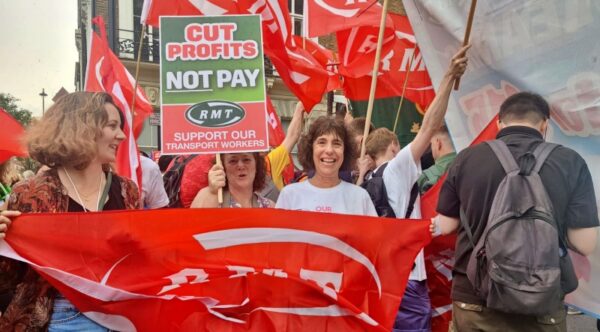
In a nutshell, I coordinate all the work which the ITF does on public transport. Of course, we work as a team, so I am not alone. For the past 10 years, we have built a global programme called Our Public Transport. The two main objectives are to win employment and organisational rights for public transport workers and to position unions to influence models of public transport, specifically to resist privation and fight for public ownership, democratic control and financing. Our approach is to contest power industrially but also politically. I am very proud of the People’s Public Transport Policy (www.OPTPolicy.org) we have developed together with ITF affiliates, which is not only a progressive policy but a campaigning and organising platform for unions linking their workplace demands with a progressive vision of public transport as a public good. In all our work, we try and strengthen the participation and leadership of women and young workers.
You have described worker education as much more than simply acquiring skills, but as a way of helping workers understand the bigger political and economic forces affecting their lives. How does worker education form a part of ITF operations?
In my work on public transport, workers’ education forms a big part of developing a shared understanding and perspective on the political economy of public transport around the world, and the forces shaping it. We try and build a critical awareness of corporations and the private interests and institutions which have a profit-making agenda, and then we look at what this means for public services, jobs and working conditions. Our education also provides a collective space for unions to explore the progressive alternatives based on their knowledge of the sector. For example, we are doing a lot now on workers’ control of technology. This process helps build union struggles against the vested interests in public transport and other public services, and shift the balance of power.
You were a member of IFWEA’s Executive Committee. (elected to the IFWEA Executive Committee at the 20th General Conference in 2007, as an ITF representative). What did you hope to contribute to IFWEA during that time, and what did you learn from being part of an international network of worker educators?
It was always important to me that IFWEA had strong participation from the international trade union movement. There is an interesting and rich mix of affiliates in IFWEA, but trade unions as representative organisations of workers must play a leading role. For me it was always important that we had a political approach to workers’ education, with a clear objective to build working class movements as a force for social change. Having the international network of workers’ educators was a powerful resource to support workers’ organisations, and a dynamic space to explore ideas, methods and solidarity.
Looking back, is there anything from your time with IFWEA that has stayed with you – perhaps an idea, a person, a debate or a particular experience – and continues to influence your work today?
I have special memories of so many wonderful people and organisations. IFWEA was always full of big characters and personalities. But if I must pick one influential experience, the international study circles programme has stayed with me. I was involved in the early days of developing the methodology, and we were experimenting with using online technology in workers’ education for the first time. It was challenging but rewarding bringing together so many countries in a participatory programme. And IFWEA’s study circle programme is much more advanced now, and that is a good sign that the foundations in the early years were strong. I do think a lot about Dave Spooner, a comrade and friend, who was very involved in this initiative as the IFWEA General Secretary and sadly passed away last year.
Your work has taken you into issues such as informal work, climate change, gender equality and public transport. How can worker education help unions tackle issues that may once have been seen as outside the traditional workplace?
I have seen time and time again, that you can’t use top-down processes to convince workers that an issue is important. Organisations can have lots of good meetings, statements and policies, but without workers’ education providing the space for workers to reflect and analyse their own experiences, we are not building the understanding and confidence needed to take collective action. It might take longer and need more resources, but the organisational results are worth it!
After all these years, what still inspires you about worker education? And what keeps you believing in its power to change things?
One of the best feelings in the world is beginning an education activity, moving through the process gradually and in a way that everyone feels listened to and heard, and ending with a strong sense of collective empowerment, strength and energy. For me, this is inspirational! Although we are living through multiple crises, every day I hear of transport workers who have changed things – it doesn’t matter how big or small – we have the collective agency, and no-one can steal that from us!